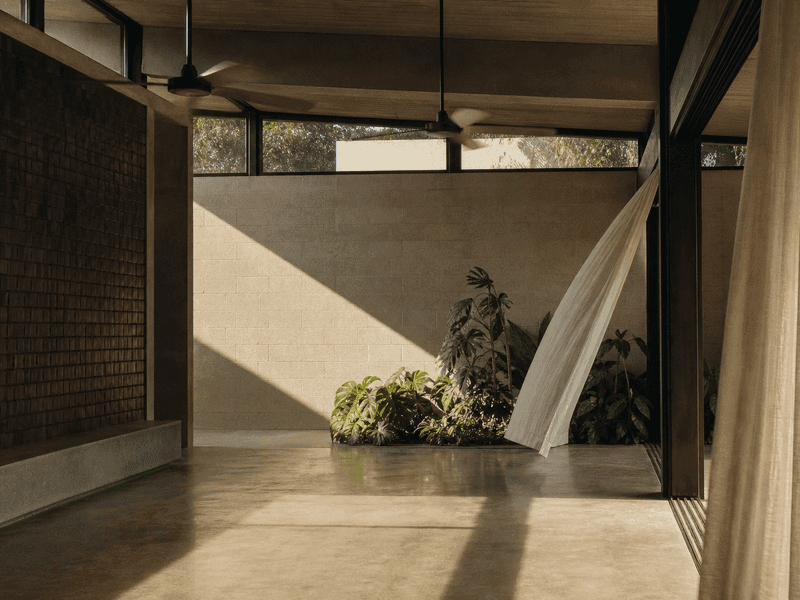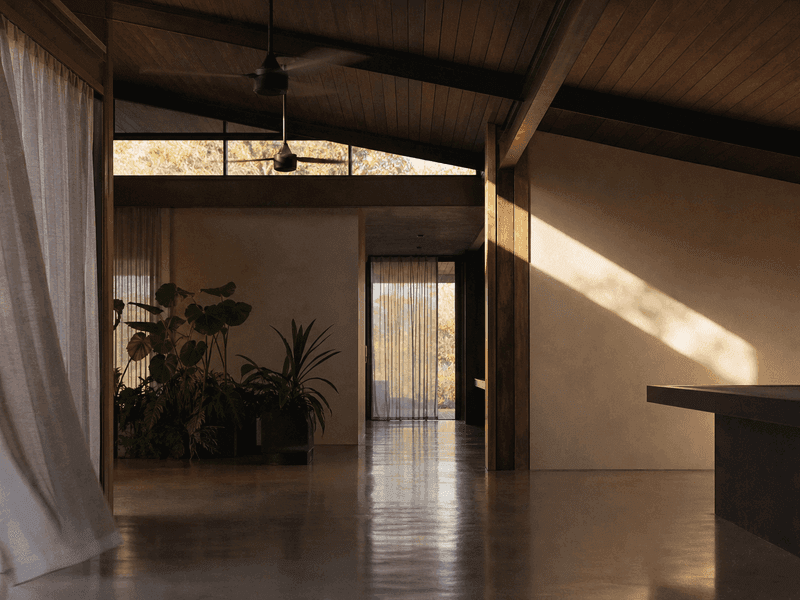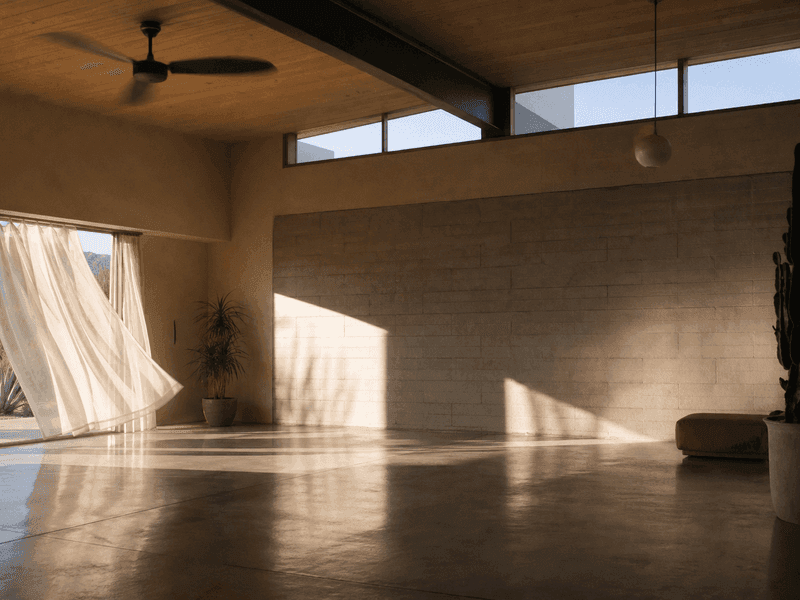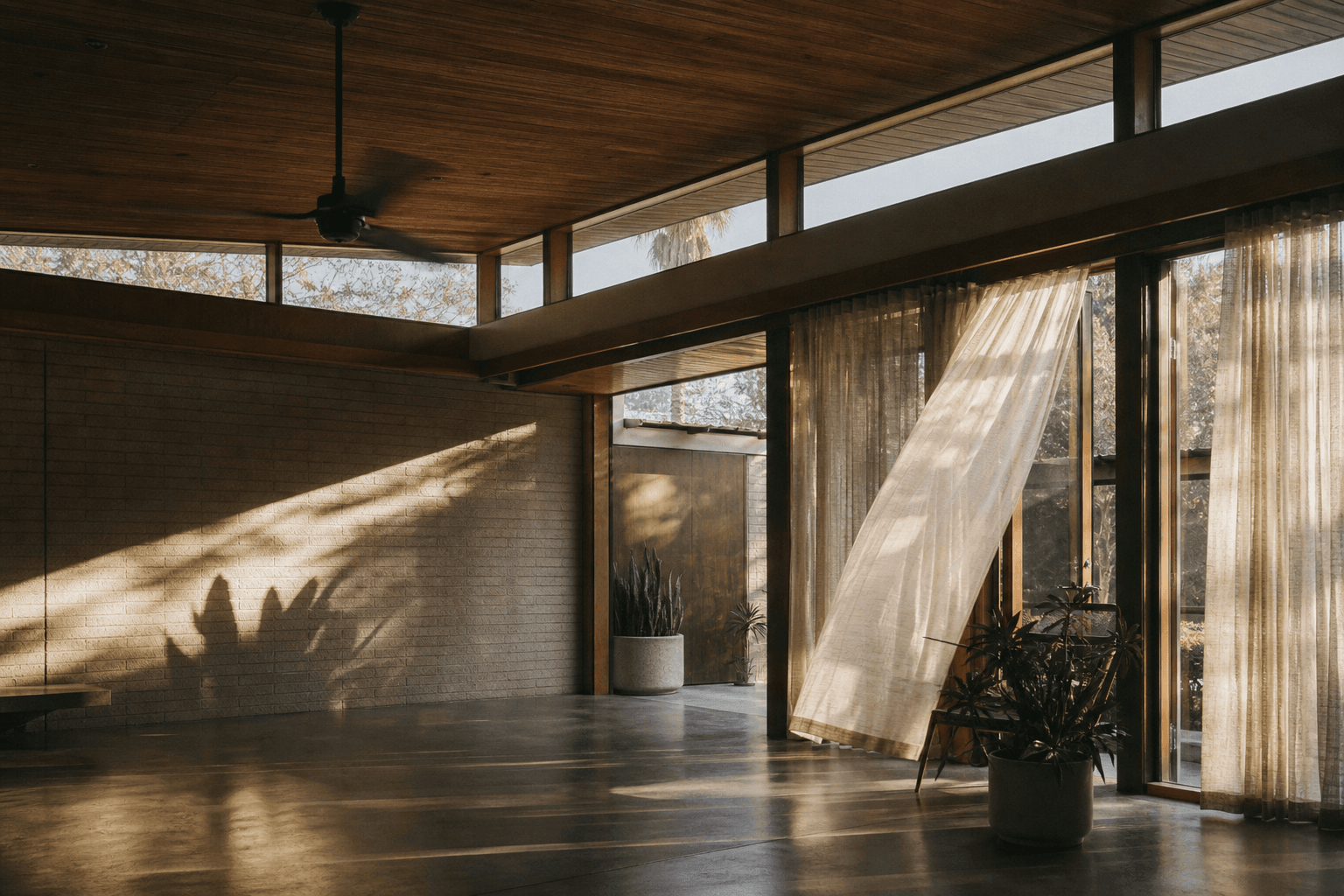
The renovation started, as many do in Paradise Valley, with a bathroom. The homeowners had bought in 2019 when the market still spoke in pale grays and matte whites — the cool minimalism that had defined Desert Modern for the better part of a decade. By 2025, the palette felt dated to them in a way they could not quite name. What they wanted, they told their designer, was for the house to feel like the place it was in. It took most of a year to finish. The result is limewash on every vertical surface, warm walnut cabinetry, a plaster range hood, and a primary bath with heated Venetian concrete floors and aged bronze fixtures. It looks, for the first time, like Arizona.
01The Shift
Arizona interiors have spent the last decade in dialogue with a particular version of Desert Modern: clean lines, cool stone, white oak, and expanses of glass that pull the landscape in without quite committing to it. That language was a correction to the heavy Tuscan and Southwestern excesses of the early 2000s, and it served its purpose well. By 2023 it had become the default for any renovation above a certain price point, which is to say it had become invisible.
What designers are describing in 2026 is a deliberate move toward warmth — not the fussy warmth of decorative southwestern motifs, but a material warmth expressed through texture, temperature, and organic variation. The triggers are multiple. The pandemic-era shift toward home as sanctuary accelerated a preference for tactile materials over slick surfaces. European influence, filtered through design media and the renovation decisions of recent California arrivals, has moved limewash plaster and aged stone from aspirational to expected in the upper tier of the Scottsdale market. And a cohort of homeowners who executed their first Desert Modern renovation in the early 2010s are now ready to revise.
02The Materials
The canonical 2026 Arizona interior renovation involves several materials that were uncommon in this market five years ago.
Limewash plaster — applied wet and worked with a brush or trowel to create depth and variation — has become the dominant wall treatment in high-end Scottsdale remodels. Unlike standard paint, it reacts to humidity and light throughout the day, giving walls a quality that reads differently in the morning than in the afternoon. Fabricators who specialize in the finish report that demand in the metro has grown significantly since 2023.
Warm wood has replaced white oak in a large portion of the market. Walnut, cerused oak in amber rather than platinum tones, and reclaimed mesquite — which carries particular resonance in Arizona for obvious reasons — are appearing in cabinetry, ceiling treatments, and flooring. The shift is not just toward warmer species but toward more visible grain and less uniform surface treatment.
Textured natural stone, particularly honed travertine and rough-face limestone, is returning after years of polished marble dominance. The appeal is partly tactile and partly visual: these materials carry the same geological register as the landscape outside, which in a house with significant glazing creates a coherence that more processed stones do not.
What they wanted was for the house to feel like the place it was in.
03The Renovation Logic
The business case for this shift is not purely aesthetic. In the Paradise Valley and North Scottsdale resale market, homes that read as current command a meaningful premium over those that do not. A renovation that refreshes the material palette of a home built or last updated in the early 2010s can move a listing from one tier to another — not because the square footage or location has changed, but because the buyer pool for a house that looks dated is smaller and more price-sensitive.
Designers working in the high-end Scottsdale market cite a consistent pattern: homes that have been updated with the current material language move faster and at stronger prices than comparable homes that have not. The materials themselves — limewash plaster, walnut, honed stone — are not inherently more expensive than what they are replacing. The labor cost for a skilled limewash application can be higher than standard painting, but it is not dramatically so. The larger cost is in intent: these renovations require a coherent design direction, which means working with someone who knows the market.
04What It Costs
A material refresh of the kind described here — limewash on main living areas, updated cabinetry finishes, new stone surfaces in kitchen and baths — runs from roughly $80,000 to $250,000 for a 4,000-square-foot home, depending on the extent of the work and the materials selected. A full renovation, including structural changes to support the indoor-outdoor transition that most of these projects also address, can reach $500,000 to $1.5 million in the Paradise Valley tier.
The return on that investment depends heavily on the entry price of the home. On a $3 million Paradise Valley property, a $200,000 material refresh that repositions the home's visual language can shift the comparable set and add $300,000 to $500,000 in perceived value — not as a guaranteed return, but as a change in the buyer conversation. At the $1 million Scottsdale level, the calculus is tighter but still generally positive in the current market.
05Who Is Doing the Work
Scottsdale and Paradise Valley have a deep bench of interior designers and architects who have moved into this material language without requiring clients to explain it to them. IMI Design Studio, Living With Lolo, and Fratantoni Design are three firms whose recent project work reflects the shift; all three operate in the upper tier of the Valley market and have experience with homes above $2 million.
For homeowners approaching a renovation in 2026, the more useful question than 'which materials?' is 'which designer understands the resale market?' An interior renovation that is aesthetically coherent but stylistically out of step with what buyers in the relevant price tier are currently responding to is a renovation that serves the current owner, not the future sale. In a market where the premium for currency is real and measurable, the distinction matters.